


Key Takeaways:
- With the stress of modern life, connection to nature is more important than ever.
- Biophilic interior design can support mental and physical well-being.
- LA’s climate and indoor-outdoor lifestyle make it one of the best cities in the world to implement this modern nature interior design philosophy.
We spend the majority of our time indoors. And while it’s more or less inevitable with modern life, it doesn’t mean we’re biologically primed for it. A lot of what we chalk up to busy schedules, like stress, poor sleep, and low energy, has much to do with our environment as anything else.
We were wired for nature, yet over the past century, we’ve created a gap between how we live and what our nervous systems need to thrive. As a species of builders, however, we’re constantly looking for solutions to “optimize.”
One of those solutions (and one of the top modern interior design trends) is “biophilic design.” This modern nature interior design trend includes the weaving of natural elements into the indoor environment, such as light, plants, water, and other organic materials.
And as a major proponent of biophilic interior design in Los Angeles, our team at 5blox Interior Design Firm believes the philosophy is one of the most effective ways to reconnect with nature.
What is Biophilic Design?
The term “biophilia” was popularized by biologist E.O. Wilson in 1984. He defined it as the “innate tendency to focus on life and lifelike processes,” noting that we have both a physiological and genetic connection to the natural world.
And while it may not feel as true today for some of us, as a species, we’ve spent hundreds of thousands of years surrounded by natural elements. Only recently, many of us have lost touch with them.
Modern nature interior design exists, in part, as a response to our biological yearning for the outdoors, even when it’s designed.
Research-Backed Benefits
The research supporting this philosophy is substantial.
A landmark 1984 study by Roger Ulrich found that hospital patients with views of nature had 30% fewer post-operative complications than patients in rooms facing a brick wall.
Similarly, Stephen and Rachel Kaplan’s Attention Restoration Theory demonstrated that natural environments restore capacity for directed attention in ways that urban environments simply don’t. And a 2008 study found that even a short walk in nature improved working memory by 20%.
In residential settings, the numbers are just as compelling. Spaces with biophilic interior design elements have been linked to measurable reductions in cortisol and blood pressure, fewer sick days, lower anxiety levels, and better sleep quality.
6 Ways to Incorporate Biophilic Interior Design
1. Living Walls and Vertical Gardens
If floor space is tight, the walls are fair game. A vertical garden, whether that’s a full living wall, a cluster of mounted ferns, or a panel of preserved moss, pulls serious weight in a room. With modern nature interior design, the possibilities are endless.
By implementing biophilic interior design on your walls, you get the visual impact of greenery and better air quality without giving up any precious square footage.
Moss walls in particular don’t need watering, sunlight, or weekly upkeep.
2. Floor-to-Ceiling Glass and Indoor-Outdoor Spaces
This is where Los Angeles homeowners have the biophilic interior design advantage. The climate allows you to erase the boundary between inside and outside almost year-round.
Sliding glass walls that fully retract. Courtyards that function as extensions of the living room. Kitchens that open directly to patios.
When combining modern nature with interior design, you stop thinking of them as separate spaces.
3. Access to Natural Light
Our bodies respond to the changes in natural light throughout the course of the day. There’s well-documented research on our circadian rhythms.
Circadian lighting systems are another biophilic interior design choice that can replicate the natural change indoors by modulating their spectral output to emulate the sun.
It sounds technical. It is. But studies show that this kind of lighting is linked to better sleep and more stable energy.
If you have large windows that get plenty of natural light during the day, take advantage of it. Heavy drapery is dark. It’s dated. It makes large rooms feel stuffy, and it’s also difficult to clean and maintain.
Instead, go sheer. Or, if privacy isn’t an issue, take down your curtains entirely.
4. Live-Edge Wood
Biophilic interior design draws on materials in their most natural form. Live-edge wood is one of those materials.
While popular for dining tables, it can just as easily be incorporated into countertops or shelving.
There’s something about wood that still looks like the outline of the tree it came from. The grain, the knots, the irregular edge. Synthetic materials have gotten very good, but that specific quality doesn’t transfer.
5. Stone, Clay, and Natural Fiber Textiles
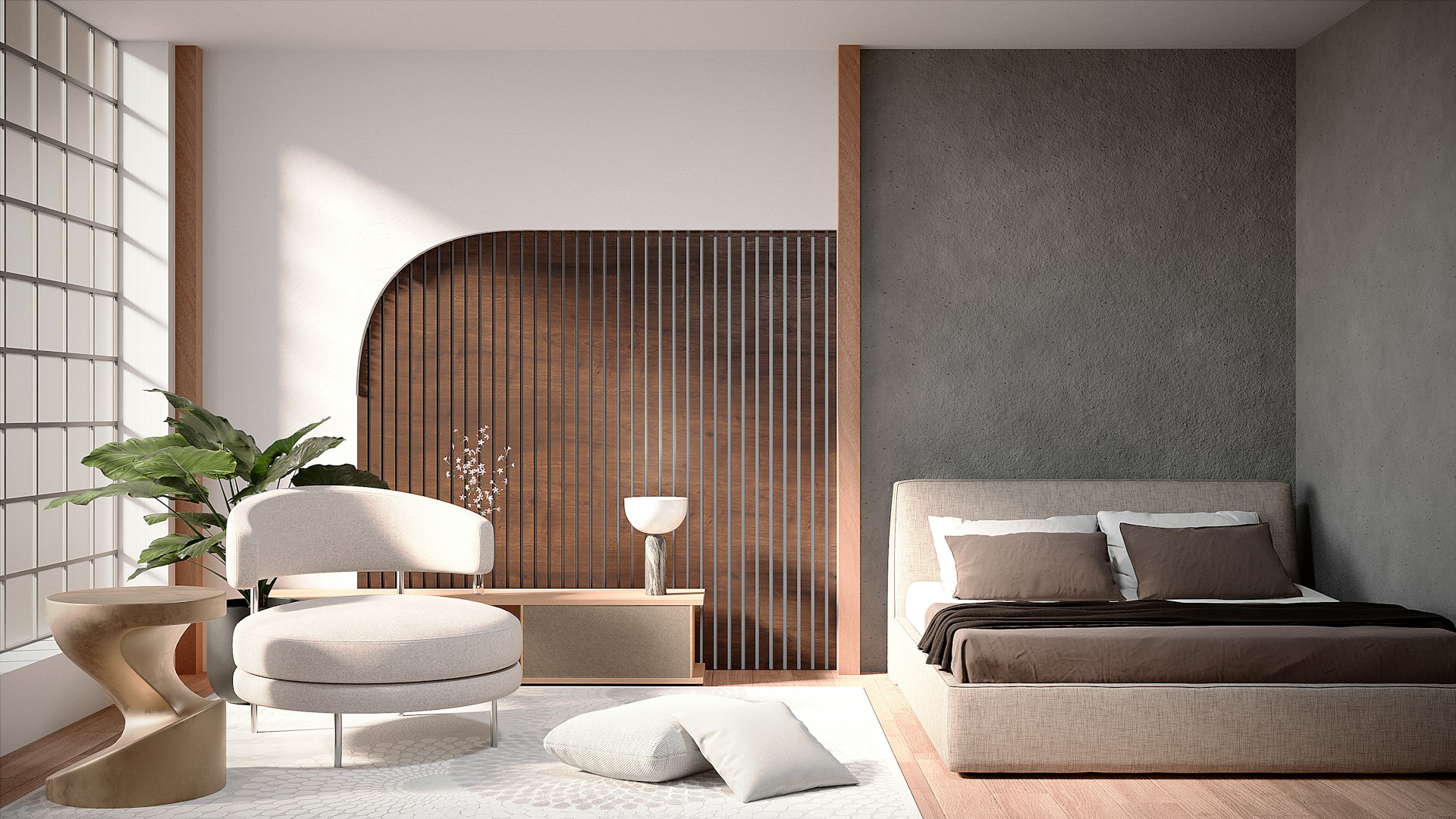
Travertine countertops. A quartzsite feature wall with earth tones. Wool throws, linen upholstery, and rattan pendant lights.
It’s important to discuss the tactile dimension of biophilic interior design in Los Angeles.
Materials that invite touch, that have temperature, texture, and variation, create a uniquely sensory environment compared to synthetic materials. This is where modern nature interior design earns its name.
6. Indoor Water Features
Moving water triggers a relaxation response that researchers have documented extensively. There are many ways to incorporate water into biophilic interior design.
A wall-mounted water feature in an entryway, a tabletop fountain in a home office, or a shallow reflecting pool in a courtyard. Each one of these introduces sound and movement that help mask urban noise and completely change the atmosphere in a room.
In a city that can be as loud as Los Angeles, the acoustic effect alone is worth the investment.
Why Los Angeles Homes are Perfect for Biophilic Interior Design
Los Angeles is uniquely suited for this approach.
You have consistent sunlight. Mild weather. Access to native plants that thrive without constant maintenance. Outdoor spaces that can function year-round.
At the same time, urban density means many people spend more time indoors than they would like. The tension between our enviable climate and indoor-heavy lifestyle is exactly why biophilic interior design is gaining traction.
It bridges the gap.
And it aligns naturally with the indoor-outdoor flow that’s such an immense part of modern nature interior design in Southern California.
If you want to see how we can help you incorporate biophilic interior design in your Los Angeles home, book a consultation with 5blox Interior Design Firm today!